 |
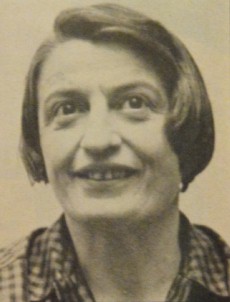 | |
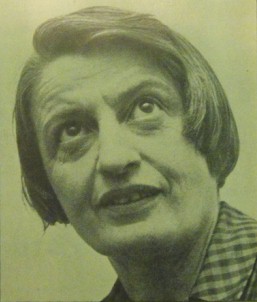
| illustrations: Ayn Rand photographed while Atlas Shrugged was nearing its publication date. (Photographer: Bob Sleppy) | ||
The first question to ask of a Presidential candidate is: does he regard the American voters as adult, responsible human beings who need all the specific knowledge he can give them, in order to pass judgment on crucial issues—or does he regard them as blind masses, incapable of connecting two paragraphs within the same speech, seeking to be taken by any leader who’ll relieve them of the responsibility of decision?
The keynote of Senator Kennedy’s acceptance speech is that there exists a “New Frontier” which requires that we elect him to the Presidency of the United States. It is, therefore, important that we understand the exact nature of that New Frontier. Here is his description of it: “We stand today on the edge of a new frontier—the frontier of the Nineteen Sixties—the frontier of unknown opportunities and perils—the frontier of unfulfilled hopes and unfilled threats.”
This sounds impressive, until one notices that instead of saying: “the frontier of the Nineteen Sixties,” one could say: “The frontier of the Nineteen-Fifties” (or “the Eighteen-Thirties” or “the Seventeen-Forties”) and that the rest of the sentence would be equally applicable. In fact, there is no decade of history to which he would not be applicable. So the only specific thing Senator Kennedy has told us about his “New Frontier” is the date. If he meant something more than what any calendar could tell us, what did he mean?
The answer is scattered through his speech like the pieces of a jigsaw puzzle that the listener has to assemble. “We must prove all over again to a watching world . . . ” says Senator Kennedy, “whether this nation—conceived as it is with its freedom of choice, its breadth of opportunity, its range of alternatives—can compete with a single-minded advance of the Communist system. Can a nation organized and governed such as ours endure?”
Senator Kennedy does not answer that question directly. But if one puts together the scattered half-answers, they add up to a loud: “No.” If any listener was left uneasy, with the dimly anxious impression that the American system was being obliterated in that speech, you will find the reasons listed below.
“Woodrow Wilson’s New Freedom,” says Senator Kennedy, “promised our nation a new political and economic framework. Franklin Roosevelt’s New Deal promised security and succor to those in need. But the New Frontier of which I speak is not a set of promises—it is a set of challenges. It sums up not what I intend to offer to the American people, but what I intend to ask of them. It appeals to their pride, it appeals to our pride, not our security—it holds out the promise of more sacrifice, instead of more security.”
Sacrifice—of what and to whom? Senator Kennedy does not specify.
Now remember that Woodrow Wilson’s policy plunged the United States into World War I and, instead of “making the world safe for democracy,” as promised, it brought into existence three new “economic and political frameworks”: Communist Russia, Fascist Italy, Nazi Germany. Franklin Roosevelt’s policy plunged the United States into World War II and, instead of achieving the “Four Freedoms,” as promised, it surrendered one-third of the world’s population into slavery to Communist Russia. In both cases, the results were the exact opposite of the promises.
If a man held those promises as his political goal, such a record would make him pause and reconsider those policies. He would ask: haven’t the American people sacrificed enough? Have their enormous sacrifices of blood, wealth and effort brought about a better world—or a chronic state of crises, emergencies and ever greater dangers, and a growing spread of dictatorships? And, asking it, he would repudiate those policies as a ghastly failure.
But if a man approved of these actual results, if he held these results—not the verbal promises—as his political goal, he would not repudiate those policies.
Senator Kennedy does not repudiate those policies. He claims them and declares his intention to carry them farther—but, this time, without the hampering pretense of any promises. Farther—where? He does not specify. He is scornful of “security,” of “normalcy,” of “private comfort.” He is scornful of “those who wish to hear more assurances of a golden future, where taxes are always low and subsidies are always high.” He envisions a government that takes, but does not give—takes taxes, but gives no subsidies, takes sacrifices, but gives no promises.
He is scornful of the Republican party as “the party of the past—the party of memory. . . . Their pledge is to the same status-quo—and today there is no status quo.” Since the American past is the political system of freedom (and Free Enterprise), it is this system that Senator Kennedy regards as only a memory. If “there is no status quo,” if we are a country with a dead past and no political system—what does Senator Kennedy intend to create for us?
“All over the world,” he says, “particularly in the newer nations, young men are coming to power—men who are not bound by the traditions of the past—men who are not blinded by the old fears and hates and rivalries—young men who can cast off the old slogans and the old delusions.”
Young men like Castro—or Nasser—or Lumumba?
There are no young men anywhere in today’s world who are coming to power to establish a system of political freedom. But there are many varieties of ambitious, power-lusting young statists of the Communist-Fascist kind, who have no political program save the use of violence, and no system, save the rule of brute force.
In the newer nations of the world, “the old slogans and the old delusions”—which those young men “cast off”—belonged to various kinds of old tyrannies (which they replace with new tyrannies of their own). But in America “the old slogans and the old delusions” to be “cast off” are the ideas and the principles of political freedom. And we ought to take Senator Kennedy’s word for the fact that he has cast them off.
“The only valid test of leadership,” he states, “is the ability to lead, and lead vigorously.”
To lead—where?
Senator Kennedy does not specify.
To a civilized mind, that “where?” is the first test of leadership, by which one judges the qualifications of any would-be leader. But to Senator Kennedy, “vigor” is the only qualification necessary. Yet the vigor of a prizefighter is not the same thing as the vigor of a scientist—the vigor of a thug is not the same thing as the vigor of a thinker—the vigor of a dictatorship is not the same thing as the vigor of the President of a free country.
Which did he mean? Senator Kennedy does not specify.
“That is the question of the New Frontier,” says Senator Kennedy. “That is the choice that our nation must make—a choice that lies not merely between two men and two parties, but between the public interest and private comfort—between national greatness and national decline—between the fresh air of progress and the stale, dank atmosphere of ‘normalcy’—between dedication or mediocrity.”
Does this awaken any echoes in your memory? Do you remember who regarded “normalcy” as “mediocrity,” scorned “private comfort” in the name of “national greatness,” and demanded the production of guns instead of butter? It was Goering.
And this seems to be the key to the riddle of Senator Kennedy. Yes, he is opposed to communism. But is he opposed to it as an advocate of the American system—or as an advocate of some “new,” home-grown version of fascism which he seeks the power to establish?
His is not the line or the style of an advocate of the American system. The American system does not regard “private comfort” and “public interest” as opposites: it regards the “public interest” of a country as consisting of the “private comfort” of its citizens. The American system has achieved the highest standard of living ever known on earth, and its progress has raised that standard ever higher for all people on all economic levels. But that is what Senator Kennedy calls “national decline” and “the stale, dank atmosphere of ‘normalcy.’” What, then, is the “abnormalcy” he advocates? What does he regard as more efficient, more practical, more conducive to national greatness? There is only one alternative: the “single-mindedness” of a dictatorship.
His is not the line or the style of a liberal, nor of a middle-of-the-road’er, nor even a naive, old-fashioned Socialist—all of whom profess to hold the welfare, the comfort, the security of their citizens as the standard of the nation’s greatness.
When a man extols “leadership”—leadership without direction—leadership without any stated purpose, program or ideal—leadership for the sake of leadership—you may be sure that you are hearing the voice of a man motivated by power-lust. It is specifically the power-lust of the Fascist variety, because the Communists promised their victims an alleged social ideal, while the Fascists offer nothing but loose talk about some unspecified form of racial or national “greatness.”
And if one keeps this in mind, the nature of the “New Frontier” becomes intelligible, and the figure emerging from the Democratic National Convention seems to step out into a different light. Is it the figure of a bright young man, or is it the figure of an irresponsible young beatnik, a high-class beatnik, who, with unlimited means at his disposal, chose the power-game, as others choose hot-rod racing—for kicks?
That figure seems to suggest the image of a cynical young man, reared in an authoritarian tradition, in the post-New Deal era, who, substituting insolence for self-confidence, seeing nothing but the range of the immediate moment, brashly proclaims that political freedom is out, dead, old-fashioned or “square,” that dictatorships are here to stay, that the rule of brute force is the mode of the future—and who longs to get into the big league of the muscle-men, to run “a race for mastery of the sky and the rain, the ocean and the tides, the far side of space and the inside of men’s minds”—to “compete with the single-minded advance of the Communist system”—to compete in the art of enslavement, expropriation, mass slaughter and military conquest—and to justify it all by means of a mysterious “New Frontier” that turns out to be nothing but the shabby old “Wave of the Future.”
|
| |
| illustrations: Ayn Rand photographed while Atlas Shrugged was nearing its publication date. (Photographer: Bob Sleppy) | ||
[Web site proprietor’s note: the text above has been corrected to add two end-quote characters where these failed to appear in the Human Events published version. I have retained the text as it appeared in the magazine insofar as “status quo” having a hyphen within it the first time the term is used but not the second and third.]
[Second web site proprietor’s note: the references within the article to Nasser and Lumumba concern African leaders of the time. Follow the links for more information.]
New content © 2010 David P. Hayes