Ayn Rand Did Not Approve of Newly-Founded Island Nations Proclaiming That Their Governments Were Based on Her Philosophy
by David P. Hayes
Readers of Ayn Rand’s novels have enjoyed Ayn Rand’s depictions of her heroes living a good life as a result of their earning the right to enjoy themselves, after having made proper choices. The Fountainhead dramatizes the triumph of Howard Roark mostly by his choices in the realm of ethics. Atlas Shrugged presents Dagny, Hank, Galt and Francisco endeavoring to make the right moral choices, too, but many of the challenges they face come from obstacles placed in their path by nemeses who manipulate tools of the political realm. For many people, a passing remark about Ayn Rand’s philosophy providing methods for successful living will have the listener assuming that the method entails brushing off only obstacles which arise in the political realm. Those of us who are better-versed in Ayn Rand’s writings know that she wrote about the full range of philosophy.
Even when Ayn Rand was alive and hearing of reader reaction in the years immediately after publication of Atlas Shrugged, there were careless readers who assumed that because she depicted a valley where residents live without formal government and yet without violation of fellow citizens’ rights, that Ayn Rand advocated for anarchy. That view is unwarranted. Ayn Rand pointed out in answer that the valley was a private society where residents came in by invitation only. Those who didn’t know of Ayn Rand’s fact-based response could have figured out for themselves that Ayn Rand could not have thought of anarchy as practicable, in that in the chapters immediately before and after the chapters of “Atlantis” and “The Utopia of Greed,” she presents near-anarchy (anarchy-by-default, it could be called — where overwhelmed local governments haven’t the resources to enforce law) as unworkable, unsafe for honest citizens, inhospitable to property rights, dismissive of views of contract-as-sacrosanct that are necessary for trade to flourish.
Ayn Rand in non-fiction she wrote after Atlas Shrugged warned against those who sought to fool her readers into buying into an approach to government that Atlas Shrugged had shown to be horrid. In a 1971 piece, she wrote, “I disapprove of, disagree with and have no connection with, the latest aberration of some conservatives, the so-called ‘hippies of the right,’ who attempt to snare the younger or more careless ones of my readers by claiming simultaneously to be followers of my philosophy and advocates of anarchism. Anyone offering such a combination confesses his inability to understand either. Anarchism is the most irrational, anti-intellectual notion ever spun by the concrete-bound, context-dropping, whim-worshiping fringe of the collectivist movement, where it properly belongs.” (Ayn Rand, “Brief Summary,” The Objectivist, September 1971)
Six years earlier, in Ayn Rand’s periodical The Objectivist Newsletter (in which all content not written by Ayn Rand was edited by her), an item appeared which indicates the approach that Ayn Rand and her associates took when confronted by promoters of this kind when they entered into events held by speakers presenting her philosophy under her auspices. The relevant excerpt:
Reports have reached me about one group that has descended to what is, perhaps, an unprecedented low in offensive absurdity. This group has decided that a large section of the public cannot be reached by abstract ideas or rational arguments, and, besides, political education takes too long, so the group will strike a major blow for freedom by taking a ‘practical’ short-cut: it will buy or lease an island, establish a free enterprise system on it, and become so prosperous that the other nations of the world will be converted to capitalism by example. (The history of the United States, or the contrast between West and East Germany, does not provide a sufficiently persuasive example, it seems.) A few emissaries from this group have shown up at NBI Tape Transcription lectures, soliciting the interest of students; local NBI Business Representatives have instructions to sweep them out when and if they appear—along with emissaries from any other such organizations.
Such groups have nothing to offer anyone, and without the sanction of those who do take ideas seriously, will fall of their own weight—or, more precisely, of their own weightlessness. [Nathaniel Branden, “A Message to Our Readers,” The Objectivist Newsletter, April 1965] [“NBI” names a specific organization which offered lectures on Ayn Rand’s philosophy with her endorsement. It was disbanded in 1968.]
As absurd as the island-government idea can strike readers, it had adherents who attempted to put it into practice. The results demonstrate that reality does not conform to wishes when those wishes are built upon bad philosophy.
Newspaper stories dated February 1972 to June 1973 chronicle the rise and fall of one such folly.
In the Republic of Minerva, which consisted of “twin coral atolls 400 miles southeast of Fiji,” dredgers hired by a Mr. “Oliver of Carson City, Nev.” “raised her highest peaks to 6 feet above high tide in January” 1972.[1] His “foundation plan[ned] to reclaim 400 acres of land and to establish a seaport settlement there for people who want to escape from crippling taxes, government interference, the rise in violent crime and the worst excesses of permissive Western society.“[2] As of July 1972, he had “already sunk 200,000 dollars of his own money into the coral reef.” In addition, “Minerva’s finances have been further strengthened by a windfall of 500,000 from two libertarian benefactors.”[3]
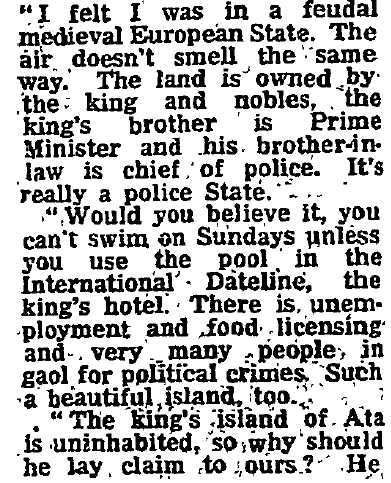
As of February 1973, it could be reported about Minerva: “At low tide, the barren reefs stick 3 feet out of the Pacific. At high tide, it slips 3 feet beneath the sea.” A Mr. Davis of Orange, Calif., was the president of the Republic of Minerva. He “has never been to Minerva”. “Davis wrote a 19-page constitution for Minerva.” He was quoted: “All of us in this are libertarians.” (No kidding!) However, he said: “The government, to our way of thinking, has one function—to protect its citizens from force and fraud.” [4] Mr. Oliver had also been quoted that “a government’s only function should be to protect against force and fraud.”[1] The wording of these statement suggests that they had inspiration from the novelist-philosopher who would have predicted that their endeavor wouldn’t work out well.
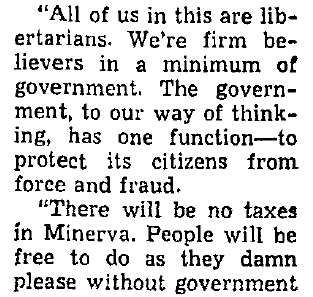
Davis also said: “If a citizen wishes to open a tavern, set up gambling, make pornographic films, whatever, the government will not interfere.” There is more to a proper government than that.[4]
The expected result was conveyed by the title of an April 1973 news story: “Want your own little island? Someone else may want it, too”
The opening paragraph reported: “The Republic of Minerva is no longer underwater at high tide, but then it is no longer the Republic of Minerva. It has been conquered by Tonga.”
The story went on:
Tonga, wary of a new neighbor and anxious over its traditional fishing grounds, ... dispatched a gang of convicts with bags of cement to build a 20-40 platform that towers 3 feet above high tide, so the reefs became land under international law.
Then the 375-pound king and a crowd of curious townsfolk piled into a copra boat and sailed for Minerva. ... And one of the convicts clobbered another with a crowbar, committing Minerva’s first known murder. [5]
If at first you don’t succeed, fail fail again? That describes what could be called “round 2.”
An organization which had “its inception in 1976” came to figure into efforts which led to armed conflict in 1980. The same Mr. Oliver who had a role in the Minerva debacle and “whose mailing address is Carson City, Nev.,” came into this second venture with a past of “representing a variety of foundation-type groups under a variety of names.” This time, the scene was “the Melanesian Island of Espiritu Santo”.[7] As before, it was a location in the South Pacific.
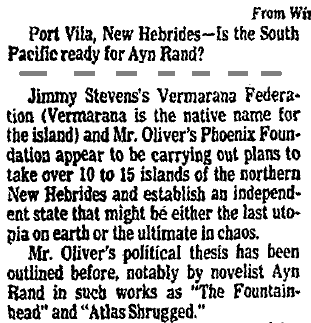
Background to this was that, even before libertarians inserted themselves into issues of sovereignty, the British and French governments had taken steps so that a “group of about 80 islands are granted independence at the end of July [1980].” Disagreement between British and French leaders of the islands were longstanding, the countries having had “joint rule of the New Hebrides since 1906—when they signed an agreement to end tension between French settlers and Scottish missionaries in the islands”. In 1980, “British-educated mostly Scottish Presbyterian blacks have won majority control of the parliamentary government that is to assume power ... But French-educated blacks have seized control of the largest island, Espiritu Santo, and set up a separate, independent state under the leadership of an Eurasian former bulldozer driver [whose] small army of 800 plantation workers, armed with spears, bows and arrows, is backed by 50 disgruntled white French plantation owners on the island and an eccentric American businessman in Carson City, Nev., named Michael Oliver.”[6] His foundation was “carrying out plans to take over 10 to 15 islands of the northern New Hebrides and establish an independent state that might be either the last utopia on earth or the ultimate in chaos.”[7] The aforementioned “small army seized key positions on Santo and imprisoned its British district commissioner and about 40 police officers loyal to” the Anglophone government.[6]
Two months later, the predicted chaos had been averted, but that was because established government had prevailed. “The arrest of a top aide to rebel leader Jimmy Stevens brought the 9-week-old bow-and-arrow rebellion on the South Pacific Island of Espiritu Santo to the brink of collapse yesterday, the government said. ... [The] secretary general of Stevens’ breakaway Republic of Vemerana, was held in Luganville for questioning.”[8]
Even Cuffy Meigs didn’t lose his revolution so decisively!
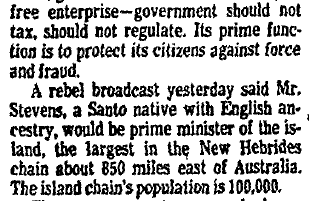
Newspaper readers of that time may have been misled into thinking that Ayn Rand would approve of such hostilities. Not only was Mr. Oliver quoted in 1980 as saying that a government’s “prime function is to protect its citizens against force and fraud,” but the news article which contained this quote begins with this paragraph: “Port Vila, New Hebrides—Is the South Pacific ready for Ayn Rand?”[7]
Unfortunately, such misrepresentation of Ayn Rand was common in the press during the years that she was writing the non-fiction which could have been consulted as reference to demonstrate that she did not hold the views ascribed to her. (In 1973, remarking on the protestations of sovereignty made by Tonga against Minerva, conservative author Russell Kirk made a snide comment in his syndicated column against Ayn Rand, blaming her for the political theory behind Minerva, he failing to heed the full context of Atlas Shrugged and Ayn Rand’s published non-fiction on government.)
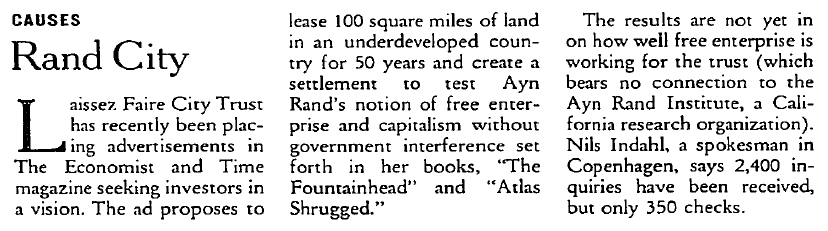
Over the next decade and a half, anyone contemplating an island-government should have seen that there was even less grounds to justify such a venture as a showpiece of the power of freedom and capitalism. The Soviet Union collapsed, bankrupt, it having suffered seven decades of low standard of living. East and West Germany reunited, the East having been shown to have impoverished its citizens, its government having established a record of shooting dead citizens who attempted to escape to the West. (Recall that the example of East and West Germany had been cited in The Objectivist Newsletter in 1965.) However, an organization named Laissez Faire City Trust was attempting to drum up interest in a prospective island-government in 1995. Perhaps as a sign of the respect that the now-deceased Ayn Rand was starting to enjoy in the mainstream culture, when The New York Times reported on the proposed development, they made a point of separating the Trust from the organization set up by Ayn Rand’s heir and others highly-knowledgeable about her legacy, informing Times readers that the trust “bears no connection to the Ayn Rand Institute.”[9]
Source Notes
[1] “Political Squalls Hit New Island Republic,” Los Angeles Times (via Manchester Guardian), May 3, 1972, pg. E3
[2] “King of Tonga v Republic of Minerva,” The Observer, June 18, 1972, pg. 5 (A similar set of facts was reported in an article titled “Undersea Nation Proclaimed,” Washington Post, February 16, 1972, pg. A21)
[3] “Checking the island king,” The Guardian, July 31, 1972, pg. 13
[4] “Minerva: nation rises at low tide,” Charles Hillinger (of the Los Angeles Times), Boston Globe, February 27, 1973, pg. 1
[5] “Want your own little island? Someone else may want it, too,” Boston Globe, April 4, 1973, pg. 2
[6] “Feud in New Hebrides Reflects Anglo-French Rivalry,” Washington Post, June 1, 1980, pg. A6
[7] “Pacific island revolt is led by businessmen,” Baltimore Sun, June 4, 1980, pg. A4
[8] “Rebel leader held,” Boston Globe, August 23, 1980, pg. 7 (The Hartford Courant, August 23, 1980, pg. 5, has a longer version of this story.)
[9] “Rand City,” The New York Times, October 1, 1995, pg. SM19
The illustrations on this page are from the following sources, listed in the order of appearance:
The Guardian, July 31, 1972
Boston Globe, February 27, 1973
Baltimore Sun, June 4, 1980
Baltimore Sun, June 4, 1980 (second selection)
The New York Times, October 1, 1995
New text, photo cropping, and all other new content on this page
© 2020 David P. Hayes